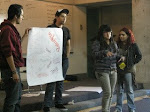
Today, we went on a Neighborhood Crawl in the Sunnydale Federal Housing Projects in San Francisco. Sunnydale is primarily an African American and Samoan neighborhood. Samoan community activists Gaynor and Ursula Siatonu of AIGA1 walked us through the neighborhood. They talked about asbestos and health issues in the Projects, told us not to be deceived by the new paint job, and shared stories of the government selling the Federal Housing Projects to a private corporation, the corporation's attempts to evict residents and gentrify the neighborhood, and their fight to keep housing for their community.
After returning from the Neighborhood Crawl, R2W Participants reflected on their experience:
Won, a Korean American from Diamond Bar, CA, said, "I learned a lot about how people are living every day."
Clinton, a Kenyan from Seattle, WA, shared, "I never knew that housing projects and poverty like that existed. Seeing it makes me want to do something about it."
Kim, a Chinese American from Alameda, CA, noticed, "Gangs in Sunnydale are fighting against themselves instead of those oppressing them - it's like civil war."
Mele, a Tongan from Reno, Nevada, felt inspired by Ursula and Gaynor:
Leo, a Pilipino from St. Paul, Minnesota, saw value in walking the streets:
Jesand, a Pilipina from Honolulu, Hawaii, named a contradiction she saw:
Lauren, a mixed race Japanese and White participant from Stockton and Sacramento learned lessons for her activism at UC Santa Cruz:
We started the day off with a Spiritual Discipline workshop on Non-Violent Communication, a practice passed down through the teachings of Ghandi and Martin Luther King Jr. Segal, a trainer from the Bay Area Non-Violent Coalition, introduced us to a new way of looking at why people do things. According to the non-violent paradigm, why do people do what they do (including things we see as positive and negative: volunteering, starting a romantic relationship, stealing, joining a gang)? They are trying to get their basic human needs met. Basic human needs are things like love, respect, support, safety, community, belonging, contribution, consideration, balance, and having enough food and resources to survive. Why do people do things like steal and murder? They are trying to get one or more of their basic human needs met.
Segal taught us that it's important to separate what people's needs are (needs) from how they are trying to meet them (strategy). Sometimes, people's strategies are destructive and hurt other people. If we can empathize with other people, see their actions as a means to get their basic human needs met, and identify these needs, we can work out a strategy that gets everybody's needs met. So, in pairs, we practiced being present for each other, being active listeners, and identifying each other's needs.
"When there's a power difference," Segal said, "you can either respond with force or you can connect with the other." Non-violent communication is about choosing to connect with the other, empathize, and see each other's humanity.
Monday, we went on a neighborhood crawl in San Francisco Chinatown. Our crawl leader was Rev. Norman Fong, a Chinatown native, pastor, and housing rights activist from Chinatown Community Development Corporation. Norman talked about the oppression and the perseverant community organizing that has taken place in the Chinatown over the last 50 years in the midst of racism and gentrification from the surrounding financial district.
Norman gave us a taste of life in a single-room occupancy unit (SRO), the living quarters above the Chinatown stores, where Chinese immigrant and Chinese American families and seniors live in 6 foot by 8 foot rooms and share a bathroom and kitchen with the other 50 units on the floor. We stuffed our group of 30 into an SRO and talked about all the issues that arise when families live in such tight spaces. He introduced us to "sardine theology", a theology that recognizes the sacredness of space in a neighborhood as dense as Chinatown. Norman shared some of the beautiful spaces that he and the community have fought to have and to keep safe, like the International Hotel (I Hotel) and community garden in the Ping Yuen Chinatown Public Housing Project.
After walking through the streets and alleys with Norman and eating a filling lunch at a local Chinese restaurant, we went to the Presbyterian Church in Chinatown, the oldest Asian American church in the United States. There, we did some talkstory with Joshua Chuck, Associate Director of Youth Ministries at Donaldina Cameron House, and R2W Program Associate Lauren Quock. Josh and Lauren represent the next generation of faith leaders who grew up in Chinatown. Josh emphasized the challenges that new immigrants face in everyday life, including being in a new place, being poor, not knowing how to speak the language, and not having a place to live or much family support. Lauren traced the culture of shame and silence in the Chinese American community back to the Chinese Exclusion Act and the fact that many Chinese came as "paper sons and daughters" with false papers.
Participants then practiced their problem posing skills by reflecting on, "Why? Why are things this way?" and proposing theories of political, economic, social, spiritual, and historical roots of the problems in Chinatown. Fela offered the theory, "If a person is disadvantaged in one way (political, social, economic, historical, spiritual), as immigrants in Chinatown are, then there is a snowball effect and they are disadvantaged in other ways as well."
A number of participants related to the oppression, Chinese culture and community hub, and community organizing they witnessed in Chinatown:
Kim, who is middle class, 3rd/4th generation Chinese American from Alameda, said, "I used to just come to Chinatown for family banquets and I used to not really like coming to Chinatown. But today, I saw a different side and came to appreciate it differently."
Nina, a Filipina from Los Angeles, said, "My community in Echo Park, Los Angeles is being gentrified, too."
Jimmy, who is Chinese and Cambodian from Oakland, said, "I understand why my house was foreclosed on now."
Clinton, who is Kenyan from Seattle, WA, said, "After hearing about the activism in Chinatown, I know that if a community can come together and get organized, it can really have an effect and make things happen."
When we go on Neighborhood Crawls, we try to remember that we are walking on sacred ground. To honor the stories, the struggles, and the history that we heard, we finished the neighborhood crawl by setting up an altar at the base of a tree in Portsmouth Square and offering fruits to those who came before us and those who live in Chinatown now.
Today, we watched Eyes on the Prize and went to City of Refuge United Church of Christ to connect the Civil Rights Movement of the 1950s & 60s with today's LGBT movement.
We started the day by grounding ourselves in history as people of color in the United States, as people of faith, and as leaders. We did this by watching a segment of Eyes on the Prize, a documentary about the Civil Rights Movement. Eyes on the Prize brought us back to 1950, a time of racial segregation and violence in the Southern part of the United States, a time when African Americans had to sit in the back of the bus, a time when African Americans had to use separate theater entrances and water fountains, a time when White men could kill a 14-year-old African American boy for talking to a White woman and be found not guilty.
It was also a time of African Americans standing up for their rights, a time when a Black woman refused to give up her seat to a White person on a Montgomery bus, a time when the African American community organized a bus boycott, a time when a young African American minister preached non-violent resistance to counter the violent acts of racism that the African American community faced in their everyday lives.
A trip to City of Refuge United Church of Christ in San Francisco was scheduled for the afternoon. City of Refuge is a predominately African American, working class and poor, LGBTQ church.
In preparation for fellowship and worship at City of Refuge United Church of Christ, two queer API R2W alumni/staff connected their struggle with the Civil Rights Movement and shared why they appreciate City of Refuge. One said, "When I think about the Jim Crow South, the image that stands out to me is of separate water fountains and theater entrances with signs above that read 'White' and 'Colored'. Today, for LGBTQ people, it's as if there is an entrance with a sign above that says 'Straight' and a sign that reads 'LGBT', but there's no entrance under it -- there's not even a door... or sometimes, there's not even a sign -- not even an acknowledgment that you exist. There are not a lot of spaces for me to be all of who I am -- Asian, queer, and Christian. I usually have to check part of myself at the door."
They shared an appreciation for City of Refuge as embodying the Civil Rights Movements of today -- a place where the African American community was creating spaces for African Americans and being intentional about welcoming LGBTQ people and lifting LGBTQ people up as leaders and ministers in the church: "City of Refuge is not just a place where we are depressed about how our lives are hard and fighting in the struggle for social justice. It's a church -- a special place where we can be all of our fabulous selves, celebrating and affirming all the diversity of God's creation. The Civil Rights Movement lives on in City of Refuge. The Civil Rights struggle continues in our generation. Martin Luther King was talking to us."
After an afternoon of worship, fellowship, and blessing at City of Refuge, R2W participants returned and reflected on the day:
Five years ago I was a participant for R2W. Since then, I've developed a strength for myself I never thought I would reach. I can't say that I did it all on my own though. I've created relationships with people who have become family to me. I am a graduate of R2W and CLI, and now I'm on staff at PANA. I've realized that I am R2W, that it'll never leave me but it was time for me to leave R2W and create space for new blood. The alumni and the "O G's" made history last night. It was emotional for me telling my story and watching my comrades tell theirs. Ose ended it with a song he wrote along with other alumni called "Change the World." It was heartwarming and gave me the goosebumps. Each of us blessed the participants one by one with a lei, offering words of wisdom on the journey they are about to embark. Honoring my voice and affirming who I am was powerful for me. Passing the torch to the next generation was good closure. Raising my consciousness about my life in context using liberating methodology, critical faith, was just the beginning for me. Now I must put theory to practice. I am excited for the new crew to experience what I was able to teach and learn in the program. Building community that is rooted in love, and taking a stand for something is revolutionary more than anything. I am curious to where life takes me next, as I make my move.
Welcome to the blogspot for R2W! We just completed our 7th year and we have documented what went on during the two weeks. We invite you to read and comment. Many participants came into the program not knowing what to expect, and now, they are back in their real worlds, taking what they have learned here.
A stand up activity: Participants represent their ethnic backgrounds, teaching the histories of their people and the struggles they face. Here are Hugo, Danny, Ale, and Giselle standing up for Mexico.
Spiritual Discipline
R2W Participants Ale, Kim, Won, and Josh practicing their spirtiual discipline through mural painting with the help of Lauren.
R2W Events 2009
Hey Everyone! I hope this note finds you all well and in good spirit. Whether by snail mail, email, facebook, myspace, our conscious faith journey continues. And it continues together as a community of young, strong, and dedicated leaders. If you need more information, feel free to contact us! Recent Events: CLI Banquet held in Los Angeles on April 18, 2009, honoring Donovan Autajay, Sophay Ferreira, Victor Mckamie, and Kristina Tran as graduates of the 2 year college program for R2W-Congressional Leaders Internship. Friends, family, and community gathered at a youth center in Echo Park to acknowledge these four strong leaders. Los Angeles grown young adults: Kristina, Victor, Donovan, and Sophay.
Victor Mckamie Senior was a proud father of Victor Jr. at the banquet and was moved to congratulate his son as well as the other CLI graduates by the growth and power they have gained from the program.
Past BLOGS!
Reflections for R2W 2008 PARTICIPANTS
Hey EVERYONE!!!! How's it going? Well, we realized that you may be very busy soaking up the sun or whats left of it ^_*, but we would still like to get reflections from you. Since we are ALL some what computer savvy, Michael thought that everyone should do their reflections as a YouTube video. Its convenient,fast, and easy! right?? hehe....^_^
Here are the following questions that you can either answer one or more!
>What is conscious faith?
>What was the most meaningful part of conscious faith to you?
>What element of Critical Faith meant the most to you - describe it
> If conscious faith changed you, your faith , your situation or perspective...talk about it.
> How did conscious faith change your relationship with your faith? your church?
**Also, you can make shout outs! - make it fun...say whatever you want to say ^_^
We hope that you are having a blessed summer. Please keep in touch during the school year.